top of page
Home
Podcast
Videos
By Topic For Educators
Contact
About
More
Use tab to navigate through the menu items.
Check out our latest Videos
Fiction Non Fiction
Sign in
Share
Play Video
Play Video
42:39
Matthew Wolfe on the Secret History of Radical Environmentalism
Journalist Matthew Wolfe joins co-hosts Whitney Terrell and V.V. Ganeshananthan to discuss his new book Fires in the Night: The Earth Liberation Front, the FBI, and a Secret History of Eco-Sabotage. Wolfe talks about the history of environmental activism, including its rarely discussed bipartisan past, and explains how industry made climate change a Democratic and progressive issue. He reflects on the impact of the Earth Liberation Front, which originated in England and developed another home in Oregon. He also unpacks their three guiding principles, including preventing harm to people, and considers law enforcement’s reaction to the radical group’s arson tactics. Wolfe analyzes the post-9/11 shift in environmental activism and the significance of the term “eco-terrorism,” which moved from describing harm done to the environment to those taking radical actions in the planet’s defense. He reads from Fires in the Night.
Play Video
Play Video
36:42
Claudia Rankine on Triage, Antigone, and Collapse
Poet, essayist, and playwright Claudia Rankine joins co-hosts Christian Barter, Jennifer Maritza McCauley and Whitney Terrell to talk about her new book Triage. Rankine outlines the decades-long relationship between the book’s narrator and a character she names “the theorist,” who, as college students, develop the habit of collapsing whenever they greet each other. She talks about how each character interprets collapse differently, the theorist prescribing action while the narrator fights for her “silences, routines, and quietude.” Rankine discusses how their “conversation” echoes Antigone and is rooted in our current reactions to the war in Gaza and the second Trump Administration. She reflects on the role that visual imagery has in her work and reads from Triage.
Play Video
Play Video
38:17
Deb Olin Unferth on Our Apocalypse Now World
Writer Deb Olin Unferth joins co-hosts Whitney Terrell and Christian Barter to discuss the enduring power of apocalyptic narratives and her new novel Earth 7. The novel follows the life of Dylan, the daughter of a researcher, cast adrift on an earth that has been depopulated by war and environmental collapse. As Dylan’s mother tries to replicate and preserve the DNA of the earth’s now extinct flora and fauna, Unferth examines how proposed scientific solutions to global warming–like carbon capture, building artificial reefs, or shooting precious metals and sulfur into the sky–may exacerbate the problems they are meant to solve. She talks about the role apocalyptic narrative plays in a world that is, in many ways, already experiencing the apocalypse. She also reflects on her decision to “lean in” to the possibility of love and hope in the last third of the novel and explains how her optimism stems from the amazing beauty of the earth that we are living on now, even as we destroy it. She reads from Earth 7.
Play Video
Play Video
42:52
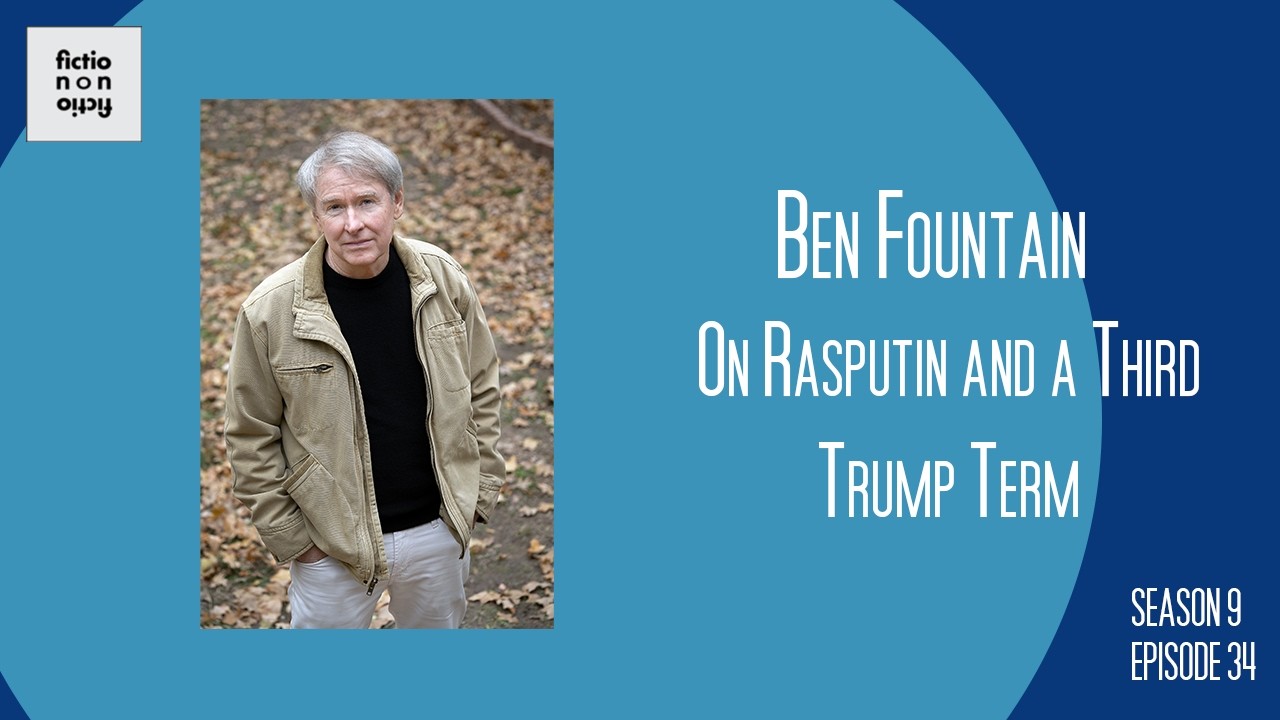
Ben Fountain on Rasputin and Trump’s Coming Third Term
Novelist Ben Fountain joins co-hosts Whitney Terrell and V.V. Ganeshananthan to discuss his new book, Rasputin Swims the Potomac. Fountain’s satire, set in the not-to-distant future, describes the furor, scandal, and hysterical “weeping sickness” that arrives in the wake of the fictional President’s decision to seek an unprecedented third term. Fountain talks about the technical choices he has made to fictionalize Trump, including the decision to redact his name. He also reflects on the roles of the other characters in the novel, including Clarence Thomas Jr., a Black reporter unrelated to the Supreme Court Judge; Faith Spack, the President’s loyal aide; and Rasputin, a professional wrestler who can cure the “weeping sickness” and begins to rival the President in popularity. Fountain explains how the political times of the original Rasputin increasingly mirror our own and reads from Rasputin Swims the Potomac.
Play Video
Play Video
36:21
Rebecca Lehmann on Anne Boleyn, Trump, and Treason
Writer Rebecca Lehmann joins co-hosts Whitney Terrell and V.V. Ganeshananthan to discuss her debut novel, The Beheading Game, a work of speculative historical fiction in which King Henry VIII’s second wife, the beheaded Queen of England Anne Boleyn, comes back to life after her wrongful execution, sews her head back on, and seeks revenge. Lehmann considers the contested history of Anne Boleyn, the outlandish accusations against her, and the ways in which her image has been erased and changed over time. She outlines the reasoning behind her portrayal of Anne, explaining how it was born out of a mix of historical fact and modern perspectives. Lehmann discusses Anne’s often forgotten role as mother to Queen Elizabeth I and how that may have shaped her motives as a queen and a politician. Lehmann also talks about similarities between the chaotic courts and allegedly treasonous advisors of Henry VIII and President Trump and the importance of scapegoats in consolidating political power. She reads from The Beheading Game. To hear the full episode, subscribe through iTunes, Google Play, Stitcher, Spotify, or your favorite podcast app (include the forward slashes when searching). You can also listen by streaming from the player below. Check out video versions of our interviews on the Fiction/Non/Fiction Instagram account, the Fiction/Non/Fiction YouTube Channel, and our show website: https://www.fnfpodcast.net/ This podcast is produced by Jennifer Maritza McCauley, V.V. Ganeshananthan and Whitney Terrell.
Play Video
Play Video
46:19
Scott Anderson on Iran
Veteran war correspondent and Kirkus Prize winner Scott Anderson joins co-hosts Whitney Terrell and Jennifer Maritza McCauley to discuss his new nonfiction book King of Kings, a history of the Iranian Revolution. Anderson examines how rapid modernization, inequality, and U.S. influence destabilized Iran, and traces the rise of Ruhollah Khomeini from exiled cleric to revolutionary leader. The conversation explores key mistakes by the Shah, the failures of U.S. intelligence, and how the revolution unfolded in unpredictable ways. Anderson also connects this history to present-day tensions, discussing Iran’s current power structure under Ali Khamenei and the global rise of religious nationalism. Finally, the hosts consider parallels between the Shah’s rule and contemporary political leadership, as well as the limits of American military strategy in the region. Anderson reads from King of Kings. To hear the full episode, subscribe through iTunes, Google Play, Stitcher, Spotify, or your favorite podcast app (include the forward slashes when searching). You can also listen by streaming from the player below. Check out video versions of our interviews on the Fiction/Non/Fiction Instagram account, the Fiction/Non/Fiction YouTube Channel, and our show website: https://www.fnfpodcast.net/ This podcast is produced by Jennifer Maritza McCauley, V.V. Ganeshananthan and
Play Video
Play Video
43:07
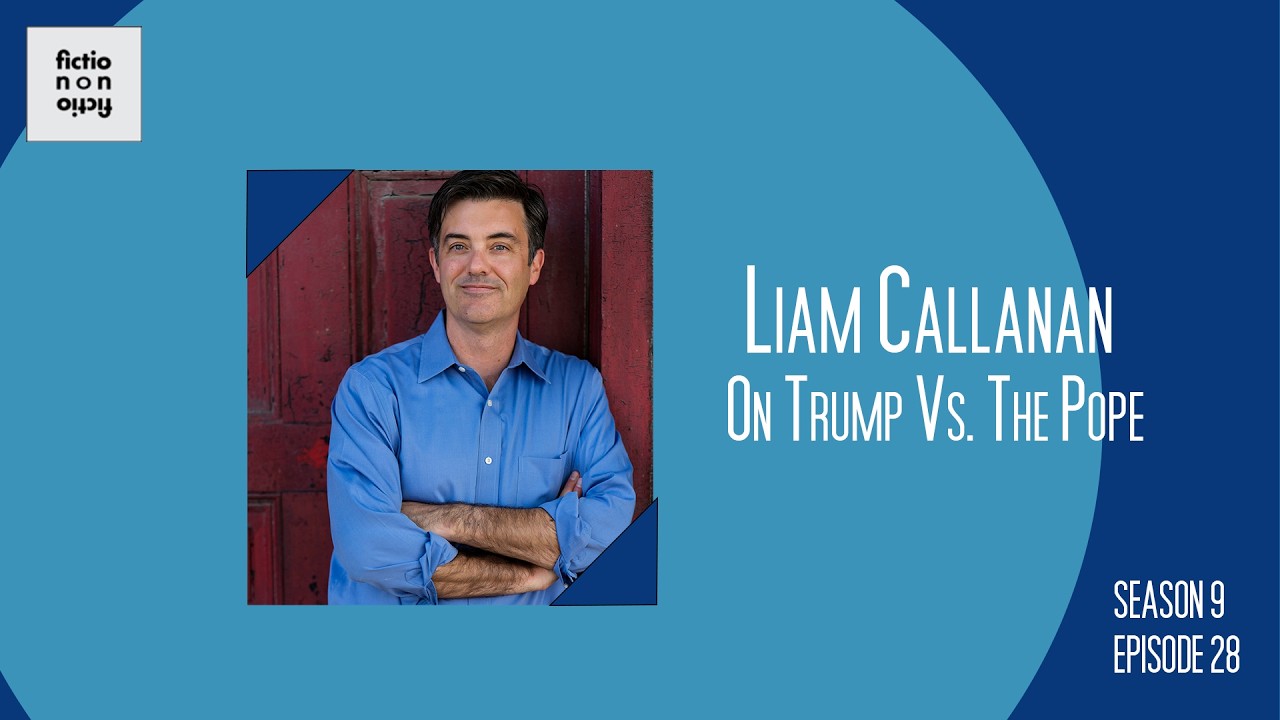
Liam Callanan on Trump Vs the Pope
Acclaimed novelist Liam Callanan joins co-hosts V.V. Ganeshananthan and Whitney Terrell to discuss American-born Pope Leo XIV’s recent conflicts with the Trump administration. Callanan, who is Catholic, contextualizes the pope’s critiques of the Iran war and other political comments within the long history of the Vatican’s outspokenness against social injustices. Callanan also talks about the heroine of his most recent novel, When in Rome, a realtor named Claire who finds herself torn between returning to an old flame and taking the veil. He explains Catholicism’s connections to writing and tells the story of his own surreal encounter with the magnetic Pope Francis, who passed away last year. Callanan previews the role faith plays in his upcoming nonfiction debut, Stone Age Astronaut, the biography of a record-setting aviator who becomes a priest. He reads from When in Rome. To hear the full episode, subscribe through iTunes, Google Play, Stitcher, Spotify, or your favorite podcast app (include the forward slashes when searching). You can also listen by streaming from the player below. Check out video versions of our interviews on the Fiction/Non/Fiction Instagram account, the Fiction/Non/Fiction YouTube Channel, and our show website: https://www.fnfpodcast.net/ This podcast is produced by Jennifer Maritza McCauley, V.V. Ganeshananthan and Whitney Terrell.
Play Video
Play Video
03:35
Caroline Bicks How King's Carrie character changed in the drafts SHORTS
Play Video
Play Video
00:54
Caroline Bicks The violence in Stephen King's writing SHORTS
Load More
bottom of page